Yamoussoukro / Factoring, stock market offences, combating money laundering and terrorist financing
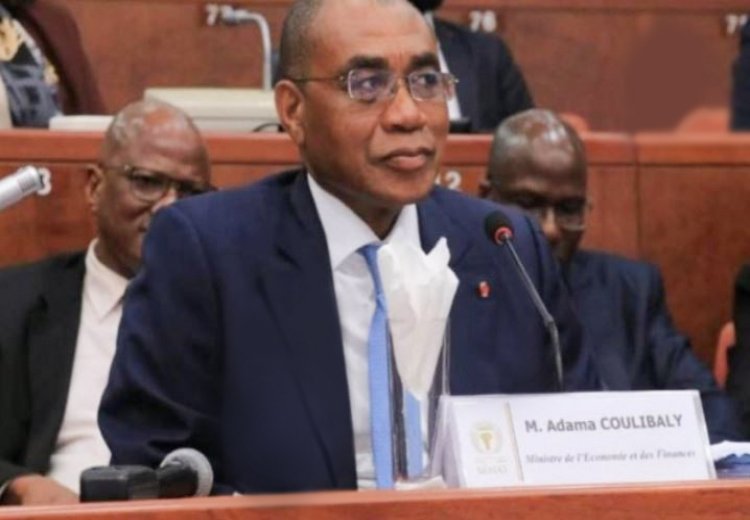
After the members of the National Assembly in December last year, senators from the Economic and Financial Affairs Committee (CAEF), as well as those from the General Affairs, Institutional Affairs and Local Authorities Committee, unanimously adopted on Tuesday 9 May the draft laws on factoring, stock market offences on the UMOA financial market, and administrative sanctions applicable to combating money laundering, terrorist financing and the proliferation of weapons of mass destruction, as well as the organisation of oversight of regulated entities. These three draft laws were presented by the Minister of Economy and Finance, Adama Coulibaly, at the premises of the Félix Houphouët-Boigny Foundation in Yamoussoukro, the seat of the Senate.
The Government's representative secured the approval of the upper house of Parliament following his explanations in the explanatory memorandum and his discussions with the distinguished senators.
With regard to the draft law on stock market offences on the UMOA financial market, Minister Adama Coulibaly said that its purpose is to ensure that misconduct on the financial market is effectively punished by establishing a range of proportionate and dissuasive sanctions. He added that the draft law also seeks to ensure more effective application of the financial market rules by creating a community framework for prosecuting criminal offences that may be committed there. Among the draft law's innovations, the Minister mentioned the introduction of settlement in criminal proceedings, under which public prosecution may be extinguished through a settlement between the Regional Council for Public Savings and Financial Markets (CREPMF, now the Financial Markets Authority, AMF; editor's note), the person being prosecuted and, where applicable, the victim of the offence. “This innovation has the merit of making the sanctions procedure more effective and less cumbersome,” he noted.
The second draft law presented by the Government's representative concerns administrative sanctions applicable to combating money laundering, terrorist financing and the proliferation of weapons of mass destruction, as well as the organisation of oversight of regulated entities. The Minister of Economy and Finance noted that, as part of the implementation of the 2021-2030 National Strategy aimed at mitigating risks, the objective is to establish administrative sanctions applicable to regulated entities. These sanctions, which will be imposed independently of the criminal sanctions provided for by the 2016 law on combating money laundering and terrorist financing (LBC/FT), have the advantage of speed, since they will enable an administrative body established for this purpose to punish breaches of the legislation without recourse to the criminal procedure under the 2016 law. The Minister Adama Coulibaly explained that, essentially, these sanctions consist of a warning, a reprimand, a temporary ban on carrying out the activity or holding management responsibilities within a legal entity carrying out that activity, for a period not exceeding five years, withdrawal of a licence or professional card, and financial penalties with a maximum amount of 50 million CFA francs (FCFA).
As for the third draft law, Minister Adama Coulibaly explained that, to facilitate access to financing for very small enterprises (TPE) and small and medium-sized enterprises (PME), the Central Bank of West African States (BCEAO) has launched initiatives to promote the development of new financing instruments for economic activities in general and SMEs in particular. These instruments include factoring, an agreement under which a financial institution (generally a credit institution), known as a factor, agrees to pay the receivables a company holds against its customers in return for the transfer of those receivables to it and remuneration in the form of commissions and interest charges. The factor, the Minister noted, thus pays the company in advance and collects the transferred receivables from the debtors. Having adopted a draft law to establish a relatively flexible legal framework that allows some flexibility in carrying out factoring transactions, the Council of Ministers of UMOA, at its December 2020 session, gave the Union's member States six (06) months to incorporate the uniform draft law into their respective legal systems. “This draft law on factoring in Côte d'Ivoire is submitted pursuant to the aforementioned decision,” Minister Adama Coulibaly specified.
SERCOM MEF