
Land and Urban Planning
Legal and regulatory framework
The Ivorian Government has adopted several texts with the aim of promoting better spatial structuring and of securing and modernising the management of urban planning and land. These texts aim to ensure the digital transformation of urban land and control of the entire parcel fabric. They thus make it possible to strengthen urban land governance through the simplification, dematerialisation and streamlining of procedures. They include, among others:
Law No. 2020-624 of 14 August 2020 establishing the code of urban planning and urban land ownership. This code organises and regulates matters relating to access to land ownership and urban planning;
Law No. 2024-351 of 06 June 2024 amending Law No. 2020-624 of 14 August 2020 establishing the code of urban planning and urban land ownership;
Decree No. 2021-862 of 15 December 2021 on the creation, powers, organisation and functioning of the Integrated Urban Land Management System (SIGFU). The SIGFU is a computerised and integrated management system for spatial and textual urban land data, enabling the complete automation of the processing chain for administrative acts;
Decree No. 2021-785 of 08 December 2021, determining the procedure for issuing the Final Concession Order (ACD);
Order No. 32 of 05 July 2022 regulating the subdivision authorisation;
Communication to the Council of Ministers No. 632 of 03 May 2023 on the introduction of the customary Right of Use Certificate (ADU) in urban land management in Côte d’Ivoire. The ADU is a single model of certificate for subdivisions involving village communities. It replaces the village certificate.
Urban planning
the Greater Abidjan Urban Master Plan (SDUGA) was adopted by Decree No. 2016-138 of 9 March 2016;
the revision of the SDUGA to the 2040 horizon is 95% complete;
the Urban Master Plan for Greater Yamoussoukro and Attiégouakro was adopted by Decree No. 2023-952 of 06 December 2023;
the Urban Master Plans of 30 regional capitals were also drawn up, approved and published in 2018;
the Urban Master Plans and Detailed Urban Plans of the departmental capitals (80 localities) are under preparation, with a physical completion rate of 80% at the end of July 2025;
the Detailed Urban Plans of the 10 urban units of the SDUGA are under preparation, with a physical completion rate of 90% at the end of June 2025;
the delimitation of 192 villages in the Abidjan District is under way (provisional plans of 102 delimited villages are available), with a physical completion rate of 65% at the end of July 2025;
the regularisation of irregular subdivisions in the Abidjan District and in towns in the interior of the country is under way (380 subdivisions rectified in Abidjan, of which 131 approved; 764 subdivisions regularised in the interior of the country, of which 98 approved).
Overall, national coverage in documents (urban master plans and schemes) is 70% in 2025
Securing the ACD issuance procedure
To increase the production of ACDs and issue secure, tamper-proof documents, the Government launched the urban land simplification and digital transformation project, through the establishment of an Integrated Urban Land Management System (SIGFU).
It is within this framework that the operation of mass titling of urban land parcels was launched. It is a structuring stage of the SIGFU, which aims to produce and issue land titles on a large scale at the time of approval of subdivisions, thereby reducing administrative formalities to the adversarial boundary marking.
The SIGFU is expected to reduce ACD issuance times by 90% and to increase the projected annual production capacity to 100,000 ACDs in the Abidjan District, compared with a current average of 15,000.
In addition, the introduction of the customary Right of Use Certificate (ADU) (replacing the village certificate) in urban land management in Côte d’Ivoire entered its application phase in July 2024 for new subdivisions. Since April 2025, the ADU has been a mandatory document for any ACD application.
Objectives of the ADU
The purpose of establishing the customary right of use certificate is to:
strengthen the State's role in supervising village communities in the management of urban land;
standardise the models of village certificates across the national territory;
control the occupation of urban space through the prior approval of subdivisions;
secure the process by which our fellow citizens acquire approved plots, by offering them a single, secure and traceable model of customary certificate;
significantly reduce disputes over plots resulting from village subdivisions.
The establishment of the ADU thus puts an end to land transactions hitherto carried out on the basis of village certificates.
Addressing and urban restructuring
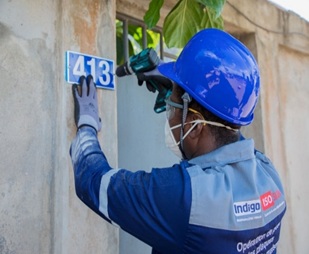
With a view to setting up a comprehensive addressing system and a single addressing reference framework guaranteeing the location and referencing of occupancy units on the road network of the Abidjan District, the Government launched the Abidjan District Addressing Project (PADA) in 2018.
Street and occupancy unit marking work is under way in the five zones of the Autonomous District of Abidjan (Zone 1: Port-Bouët, Marcory, Koumassi and Treichville; Zone 2: Plateau, Adjamé, Attécoubé East; Zone 3: Cocody and Bingerville; Zone 4: Abobo and Anyama; Zone 5: Yopougon, Attécoubé West and Songon). More than 15,000 names for boulevards, avenues and streets have been approved.
The addressing system via Google Maps is in effect in Zone 1 and Zone 2. The installation of occupancy unit plates is complete in Zones 1 and 2, and continues in Zone 3.
In addition, the Addressing Project for Towns in the Interior (PAVI) was launched in 2023 in the localities of Daloa, Korhogo and Yamoussoukro. The status of implementation at the end of June 2025 is as follows:
In Yamoussoukro, the surveys and marking (26,840 occupancy units) are complete, including the activities to reposition street signs;
In Korhogo, 69,188 occupancy units have been surveyed and 58,431 have been marked;
In Daloa, 61,779 occupancy units have been surveyed and 39,048 have been marked.
The address of the Plateau District Hall will be as follows: 495, Boulevard de la REPUBLIQUE 00217, Abidjan – Plateau
|  |
As regards urban restructuring, a Development Project for Restructured Neighbourhoods of Abidjan (PAQRA) was initiated in 2018 in five neighbourhoods of Abidjan (Abobo pk 18; Yopougon Gesco; Koumassi grand campement, Koumassi Divo 1 and Koumassi Divo 2). It aims to raise the level of basic urban services (roads, sanitation, electricity, drinking water, socio-educational and health facilities). The detailed project management studies for these 5 pilot neighbourhoods are complete.
Outlook
Future actions in urban planning will focus on:
the adoption of the decree creating the fund to finance the establishment of land reserves and urban development;
the development of the urban public policy;
the continued clean-up of urban land and improvement of the functioning of the mortgage guarantee system by making land procedures and cadastral mapping more reliable;
the completion of the Urban Master Plans and Detailed Urban Plans of the departmental capitals (80 localities);
the updating of the Urban Master Plans (PUD), the preparation of the Detailed Urban Plans (PUd) and the Strategic Plans for Economic and Local Development of six regional capitals (Man, Odienné, Ferkessédougou, Bouna, Boundiali and Korhogo);
the start of the delimitation of village territories in the interior of the country;
the continued delimitation of village territories in the Autonomous District of Abidjan;
the continued rectification/regularisation of applied but unapproved subdivisions in Abidjan and in the interior of the country;
the continued implementation of the development project for five (05) restructured neighbourhoods of Abidjan (PAQRA);
the completion of the addressing of the Autonomous District of Abidjan;
the completion of the implementation of the Addressing Project for Towns in the Interior (PAVI) in Yamoussoukro, Daloa and Korhogo.