
Food-crop farming
Agriculture is a strategic pillar of the economic and social development of Côte d’Ivoire. As the leading provider of jobs and the main driver of exports, the sector plays a decisive role in social stability, rural poverty reduction and food security. Its contribution to GDP stood at 15.0% in 2024, compared with 15.2% in 2023.
Food-crop farming, for its part, occupies a predominant place in the national economy, with a share of 5.7% of GDP in 2024, after 5.8% in 2023.
The development strategy for food-crop farming is part of the Ivorian Government’s overall vision of having: “ a sustainable, competitive Ivorian agriculture that creates equitably shared wealth ” and of complying notably with Goal No. 2 of the Sustainable Development Goals (SDGs), which calls on countries to eradicate hunger and all forms of malnutrition.
In this context, a first National Agricultural Investment Programme, which mobilised 1 600 billion CFA francs (FCFA) out of 2 040 billion FCFA, was implemented over the period 2012 – 2017 (PNIA 1), followed by a second programme, PNIA 2, covering the period 2018 – 2025.
PNIA 2, whose cost is estimated at 12 315 billion FCFA in 2024, split between public investment (35%) and private investment (65%), is a key driver of agricultural development and the processing of agricultural products.
The implementation of two National Agricultural Investment Plans (PNIA 1 and 2) has given the sector a clear strategic direction and served as the basis for the agricultural phases of the National Development Plan (PND 2021-2025). The development strategy rests on:
grouping the country’s various regions into Agro-Poles on the basis of agro-ecological, administrative, social and economic criteria;
the promotion of sustainable agriculture ;
the promotion of agricultural interprofessional bodies, a genuine tool for dialogue between producers, processors, traders and exporters on sector policies.
For about twelve years, the Government has carried out an in-depth reform of agricultural governance in order to modernise value chains, strengthen transparency and guarantee fairer remuneration for producers.
The State has also strengthened its support to the private sector through structural financing, such as PURGA 1 & 2 (85 billion FCFA) and a cost-sharing fund (FCP) of 43 billion FCFA in the agricultural sector, which aims to :
support small and medium-sized enterprises (SMEs/PMEA),
promote mechanisation,
support the adoption of new technologies,
strengthen the competitiveness of agricultural value chains.
A cost-sharing fund is a financing mechanism put in place by the State (sometimes with the support of technical and financial partners) to support private initiatives, while sharing the risks and financial burdens with the beneficiaries. In practical terms:
the State (or the project) covers part of the investment costs (training, equipment, innovation, research, technical support, etc.),
the beneficiary (company, cooperative, producer) finances the other part,
the objective is to encourage the private sector to invest in innovative, productive or structuring projects, by reducing its level of risk and increasing its access to finance.
This mechanism made it possible to subsidise more than 1 012 projects by private actors (legal entities or individuals) in 2024, amounting to 13.2 billion FCFA and covering up to 90% of the cost of their investments.
The Cost-Sharing Fund (FCP) under the Food Value Chains Development Project (PDC2V) is a successful example of its implementation in the agricultural sector in Côte d’Ivoire. It aims to help actors in food value chains (such as cassava, vegetables, fish farming) to make investments (production, storage, processing, marketing) by sharing the costs between the State/public projects and private beneficiaries. This is intended to overcome difficulties in access to credit and to encourage productive private investment.
Characterisation of the Agro-Poles
An Agro-Pole is a grouping based on agro-ecological criteria, which allows crops requiring similar climatic conditions to be prioritised in the same zones. It enables producers to benefit from specific government services such as extension services, subsidies and input distribution.
Nine (09) Agro-Poles have thus been identified on the basis of these groupings since 2019. The map below (figure 1) illustrates the proposed zoning and the industrial export crops concerned (table 1).
To date, two (02) of these Agro-Poles are being implemented with public financing of 247.4 billion FCFA. They are:
Agro-Pole 4, through the Agro-Industrial Poles Project -2PAI-Bélier for an amount of 80.99 billion FCFA;
Agro-Pole 1, through the Agro-Industrial Poles Project -2PAI-Nord for an amount of 163.81 billion FCFA.
These Agro-Industrial Pole Projects (2PAI) have mobilised more than 200 million dollars of investment, thereby fostering the emergence of new agro-industrial companies and job creation. As pillars of PNIA 2, these Agro-Poles have seen their operations intensify, with an emphasis on crop diversification, farmer training, access to agricultural inputs, storage of products in food-crop collection centres and, above all, processing of products.
Map of the Agro-Poles of Côte d’Ivoire
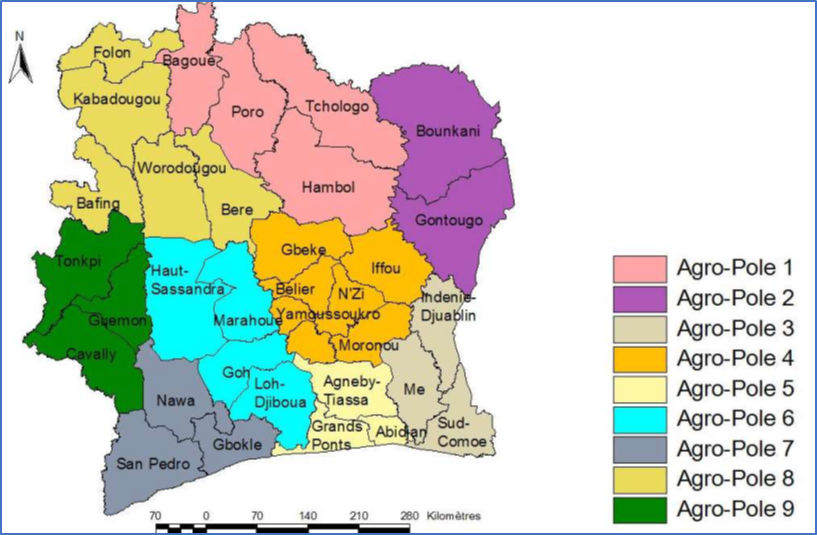
Sources: MEMINADERPV/DSDI
Main food crops of the Agro-Poles
| Zone | Food crops concerned | Status |
| Agro-Pole 1 | Maize, Rice, Onion | Operational under the name 2PAI-Nord |
| Agro-Pole 2 | Yam, Market-garden crops | Started in 2025, under the name 2PAI-Nord-Est |
| Agro-Pole 3 | Cassava, Plantain, Market-garden crops | Search for financing under way |
| Agro-Pole 4 | Yam, Cassava, Rice | Operational under the name 2PAI-Bélier |
| Agro-Pole 5 | Rice, Market-garden crops, Cassava | Search for financing under way |
| Agro-Pole 6 | Yam, Cassava, Rice | Search for financing under way |
| Agro-Pole 7 | Cassava, Plantain, Rice | Search for financing under way |
| Agro-Pole 8 | Rice, Maize, Soybean | Search for financing under way |
| Agro-Pole 9 | Rice, Cassava | Search for financing under way |
Sources: MEMINADERPV/DSDI
Food-crop production
In 2024, food-crop production as a whole recorded good growth, with more than 23.65 million tonnes compared with 22.4 million tonnes in 2023, an increase of 5.73%.
In about twelve years, food-crop production has more than doubled, rising from 12.5 million (2012) to 23.6 million tonnes (2024). The cereal needs coverage rate rose from 48.3% to 61.5%, and from 79.8% to 100% for roots, tubers and plantain.
To reduce post-harvest losses, estimated at between 30 and 40%, several initiatives have been deployed:
29 743 km of rural tracks have been developed or rehabilitated;
397 storage warehouses, with a capacity of 38 000 tonnes, have been built;
06 collection centres and 15 rural markets have been set up;
2 033 tricycles and 34 trucks have been distributed to producer organisations to facilitate the movement of produce to market.
• Cereals
The main cereals produced by Côte d’Ivoire are, in order, paddy rice, maize, sorghum and millet.
Between 2015 and 2024, maize, millet and sorghum production show average annual growth rates of 7.25%, 0.97% and 2.12% respectively.
Maize cultivation benefits from the production and distribution of seeds and the distribution of inputs (plant material and fertilisers).
As for rice, one of the main staple foods, its production fell by an average of 7.2% per year between 2015 and 2020. This decline is due, among other things, to the insufficient supply of improved seeds, the limited intake capacity of processing units and insufficient financing of the paddy sector.
However, a recovery has been observed since 2020, with average annual growth of 12.6% between 2020 and 2024 thanks to the reforms undertaken, notably an extension of the areas sown and intensification with better productivity (average yield rising from 2.3 tonnes/hectare in 2020 to 3.32 tonnes/hectare in 2024).
Cereal crops such as millet, sorghum and fonio, although benefiting from efforts to mechanise cultivation and harvesting in the sector, suffer from the effects of climate change, labour shortages and damage caused by livestock.
Production of the main cereals (in thousands of tonnes)
| Cereals | 2015 | 2016 | 2017 | 2018 | 2019 | 2020 | 2021 | 2022 | 2023 | 2024 |
| Rice (paddy) | 2 152,9 | 2 054,5 | 2 119,6 | 2 006,8 | 1 88,4 | 1 481,2 | 1 659 | 1 703,5 | 2 011,5 | 2 381,1 |
| Maize | 906,1 | 967,2 | 1 025,2 | 1 055 | 1 102,4 | 1 175,7 | 1 139,6 | 1 199,3 | 1 416,2 | 1 701, 4 |
| Millet | 55,2 | 58,3 | 61,6 | 63,8 | 66,2 | 69,5 | 67,4 | 70,1 | 62,1 | 60,2 |
| Sorghum | 55,1 | 58,8 | 63,1 | 65,8 | 67,9 | 72,2 | 70,2 | 73,3 | 65,4 | 66,5 |
Sources: MEMINADERPV/DSDI
- Roots, tubers and plantains
The main crops produced in Côte d’Ivoire are yam, cassava and plantain, which recorded average annual growth of 1.58%, 7.60% and 3.95% respectively between 2015 and 2024. Production covers most of national consumption needs.
Côte d’Ivoire also produces sweet potato and taro, which grew by an average of 2.42% and 1.70% per year respectively over the period 2015-2024.
The cassava sector accounted for more than 45% of tuber production in 2024. It has benefited from several programmes to increase production, notably the Project to Support the Development of the Cassava and Market-Garden Sectors (PRO2M) and PNIA 2. Cassava is on its way to becoming the country’s main source of food supply. The Government has financed the establishment of 26 semi-industrial processing units, 190 artisanal processing units and 2 Mechanised Agricultural Service Delivery Centres (CPSAM).
Government action has contributed to the development of 340 hectares under water control.
Production of the main roots, tubers and plantains (in thousands of tonnes)
Roots, tubers and plantains | 2015 | 2016 | 2017 | 2018 | 2019 | 2020 | 2021 | 2022 | 2023 | 2024 |
| Yam | 6 649,9 | 6 894,5 | 7 148,1 | 7 391,1 | 7 450,5 | 7 654,6 | 7 589,8 | 7 786,1 | 7 471,7 | 7 660,9 |
| Cassava | 4 390,9 | 5 269,1 | 5 366,5 | 5 608 | 5 877,2 | 6 443,6 | 6 302,3 | 6 804,1 | 8 248,2 | 8 485,7 |
Banana plantain | 1 739,1 | 1 809,3 | 1 882,3 | 1 955,7 | 2 030 | 2 082,8 | 2 030,6 | 2 109,3 | 2 311,7 | 2 465,2 |
| Sweet potato | 50,9 | 52,4 | 54,1 | 55,6 | 57,2 | 58,0 | 56,8 | 58,7 | 61,5 | 63,1 |
| Taro | 78,4 | 80,7 | 83,1 | 85,3 | 87,9 | 89,2 | 87,7 | 90,4 | 89,4 | 91,2 |
Sources: MEMINADERPV/DSDI
- Roots, Tubers and Plantains
The main crops produced in Côte d’Ivoire are yam, cassava and plantain, which recorded average annual growth of 1.58%, 7.60% and 3.95% respectively between 2015 and 2024. Production covers most of national consumption needs.
Côte d’Ivoire also produces sweet potato and taro, which grew by an average of 2.42% and 1.70% per year respectively over the period 2015-2024.
The cassava sector accounted for more than 45% of tuber production in 2024. It has benefited from several programmes to increase production, notably the Project to Support the Development of the Cassava and Market-Garden Sectors (PRO2M) and PNIA 2. Cassava is on its way to becoming the country’s main source of food supply. The Government has financed the establishment of 26 semi-industrial processing units, 190 artisanal processing units and 2 Mechanised Agricultural Service Delivery Centres (CPSAM).
Government action has contributed to the development of 340 hectares under water control.
Production of the main market-garden crops and pulses (in thousands of tonnes)
Roots, tubers and plantains | 2015 | 2016 | 2017 | 2018 | 2019 | 2020 | 2021 | 2022 | 2023 | 2024 |
| Yam | 6 649,9 | 6 894,5 | 7 148,1 | 7 391,1 | 7 450,5 | 7 654,6 | 7 589,8 | 7 786,1 | 7 471,7 | 7 660,9 |
| Cassava | 4 390,9 | 5 269,1 | 5 366,5 | 5 608 | 5 877,2 | 6 443,6 | 6 302,3 | 6 804,1 | 8 248,2 | 8 485,7 |
Banana plantain | 1 739,1 | 1 809,3 | 1 882,3 | 1 955,7 | 2 030 | 2 082,8 | 2 030,6 | 2 109,3 | 2 311,7 | 2 465,2 |
| Sweet potato | 50,9 | 52,4 | 54,1 | 55,6 | 57,2 | 58,0 | 56,8 | 58,7 | 61,5 | 63,1 |
| Taro | 78,4 | 80,7 | 83,1 | 85,3 | 87,9 | 89,2 | 87,7 | 90,4 | 89,4 | 91,2 |
Sources: MEMINADERPV/DSDI
- Market-garden crops and pulses
The main market-garden crops produced in Côte d’Ivoire are okra, aubergine, tomato and chilli pepper.
From 2015 to 2021, okra and aubergine production increased by an average of 3.97% and 1.85% per year respectively.
However, in 2022, okra and aubergine production fell by 58.8% and 18.1% respectively compared with 2021. This situation is explained by attacks by “jassids” (pest insects) that occurred in July 2022 in the cotton basin. Okra and aubergine production rebounded in 2023 with increases of 114.9% and 34.4% respectively, thanks to control of the “jassid” invasion. In 2024, increases of 10.0% and 2.7% respectively were observed.
Tomato production recorded continuous growth over the period 2015-2024, with an average annual growth rate of 5.64%.
As for groundnut, the main pulse of Côte d’Ivoire, its production increased over the period 2015-2024 at an average annual rate of 10.07%.
The market-garden sector benefits from the spin-offs of the Hydro-Agricultural Development Project in the Folon and Kabadougou Regions (PAHA FK), which aims at additional annual production of 4 800 tonnes, and of the Hydro-Agricultural Development Project in the Haut Sassandra and Fromager regions (PAHAHSF), which provides for between 4000 and 6160 tonnes of additional production.
In addition, PRO2M has made it possible to (i) promote a more professional, high-performing, organised market-garden sector that creates jobs, and (ii) achieve annual market-garden production of about 8 300 tonnes, ensured in all seasons by more than 2000 beneficiaries (including women and young people), 42 agro-entrepreneurs and 33 groups.
More than 2000 ha of irrigated perimeters have raised market-garden production to more than 363 000 tonnes in 2024, with a needs coverage rate estimated at 64.2%.
Production of the main market-garden crops and pulses (in thousands of tonnes)
| Market-garden crops and pulses | 2015 | 2016 | 2017 | 2018 | 2019 | 2020 | 2021 | 2022 | 2023 | 2024 |
| Aubergine | 96,3 | 99 | 101,8 | 103 | 106,1 | 109,1 | 107,5 | 88,1 | 118,3 | 121,5 |
| Tomato | 36,8 | 38,2 | 39,5 | 44,1 | 45,4 | 47,3 | 46,6 | 48,1 | 53,5 | 60,3 |
| Okra | 147,3 | 152,5 | 157,9 | 176,1 | 181,3 | 188,7 | 186,1 | 76,7 | 164,8 | 181,3 |
| Groundnut | 178,8 | 190,1 | 202,1 | 209,5 | 217,6 | 227,6 | 233,9 | 243,4 | 277,1 | 296,7 |
| Chilli peppers | n/a | n/a | 305,8 | 309,3 | 318,6 | 327,5 | 322,9 | 264,5 | 355,3 | 408,6 |
Sources : MEMINADERPV/DSDI
Outlook
With a view to ensuring food security, the Government aims: (i) to increase rice, maize and cassava production by strengthening agricultural production techniques, notably by improving access to suitable agricultural advisory services under the Emergency Agricultural Programmes Project (2PAU-CI), (ii) to improve vulnerable households’ access to foodstuffs, and (iii) to organise food security reserves by establishing an institutional framework for managing food reserves and food security storage infrastructure.
The Government intends to continue and deepen the transformation of the agricultural sector around the following priorities:
Mechanisation, through the establishment of agricultural service delivery centres in all agro-ecological zones ;
Modernisation of cash-crop sectors, through the promotion of sustainable agriculture and the extension of social coverage to all producers ;
Securing land tenure, with the objective of national coverage of rural land by 2030, with the continued deployment of village committees. Secure access to land is a major issue for social peace and agricultural investment. To this end, the National Strategy (SNSFR) and the National Rural Land Tenure Security Programme (PNSFR) have been updated, with an ambitious objective of covering the national territory by the target date.
Continuation of inclusive policies on access to finance, land and training for young people and women.
Government interventions will also aim to improve access to quality inputs by setting up and improving seed processing and storage infrastructure and strengthening the system for controlling the production, marketing and use of inputs.
Reference documents :
- Strategic Orientations PND 2021-2025, Volume 2
- PNIA 2 Report, September 2017
- PNIA 2 Report, September 2023
- Agricultural Statistics Yearbook, 2022-2023 edition
- Agricultural Statistics Yearbook, 2024 edition
- Macroeconomic framework of 08 April 2025.