The IMF reaches a staff-level agreement with Côte d’Ivoire on the first review of the EFF (MEDC)/ECF (FEC) arrangement
End-of-mission press releases contain statements by IMF staff teams describing their preliminary findings following visits to a country. The views expressed in this statement are those of IMF staff and do not necessarily represent those of the IMF Executive Board. Based on the preliminary findings of this mission, IMF staff will prepare a report which, subject to management approval, will be submitted to the Executive Board for consideration and decision.
- The Ivorian authorities and IMF staff have reached a staff-level agreement on the first semi-annual review of the authorities’ economic reform programme, which is supported by an IMF financing arrangement under the EFF (MEDC)/ECF (FEC) facilities for an amount of 2.6 billion SDRs (DTS) (about 3.5 billion U.S. dollars).
- The authorities are advancing their economic transformation programme under the National Development Plan 2021-25. They have taken measures to strengthen macroeconomic stability and address fiscal and external imbalances as the economy is being severely affected by the triple shock of the Covid-19 pandemic, global financial tightening and the adverse effects of the war in Ukraine.
- Approval of the review by the IMF Executive Board will result in a disbursement of about 500 million U.S. dollars.
Abidjan, Côte d’Ivoire: An International Monetary Fund (IMF) staff team, led by Mr Olaf Unteroberdoerster, visited Abidjan from 19 September to 2 October to discuss progress under the authorities’ economic programme, supported by an EFF (MEDC)/ECF (FEC) arrangement amounting to 2.6 billion SDRs (DTS) or 3.5 billion U.S. dollars and approved by the IMF Executive Board on 24 May 2023. The IMF Executive Board Approves a 40-Month, US$3.5 Billion Extended Fund Facility and Extended Credit Facility Arrangement for Côte d’Ivoire (imf.org).
At the end of the visit, Mr Unteroberdoerster issued the following statement:
“Discussions during the first semi-annual review of the Fund-supported programme were very productive. I am pleased to report that programme performance has been satisfactory so far and that we have reached a staff-level agreement on all policies, including the key parameters of the 2024 fiscal framework and upcoming reform measures in line with the programme’s objectives. Completion of the programme review and disbursement of the next tranche of about 500 million U.S. dollars will be subject to approval by the IMF Executive Board.
“Following successive global shocks and mounting imbalances through end-2022, the IMF-supported programme aims to preserve macroeconomic stability and support Côte d’Ivoire’s transition to upper-middle-income country status over the medium term. Despite a difficult outlook and persistent adverse external headwinds, growth proved resilient in 2023, estimated at 6.4%, while inflation declined to about 4.7% (annual average). Improved tax revenue collection is expected to help reduce the fiscal deficit in 2023 to 5.3% of GDP. Nevertheless, the current account deficit remains high and is expected to decline moderately to 5.8% of GDP, as strong domestic demand continues to drive imports.”
“Discussions focused on revenue mobilisation to preserve the sustainability of public finances and debt and anchor the National Development Plan (NDP) 2021-2025. Continued determined programme implementation will aim to further reduce the fiscal deficit to 4.0% of GDP in 2024, while measures estimated to increase revenue by 0.5% of GDP will be essential to preserve Côte d’Ivoire’s moderate risk of debt distress rating. Continued gradual reduction of the current account deficit should help ease external pressures and enable Côte d’Ivoire to contribute to a gradual rebuilding of regional official reserves.
Work on a comprehensive medium-term revenue mobilisation strategy is under way and should be adopted by the Government in May 2024. The strategy will help continue tax policy and tax administration reforms with a view to gradually achieving the WAEMU tax burden target of at least 20% of GDP. Other structural reforms during the first year of the programme will focus on improving the business climate to support private sector-led and more inclusive growth by strengthening public financial management and financial inclusion, as well as governance and the fight against corruption.”
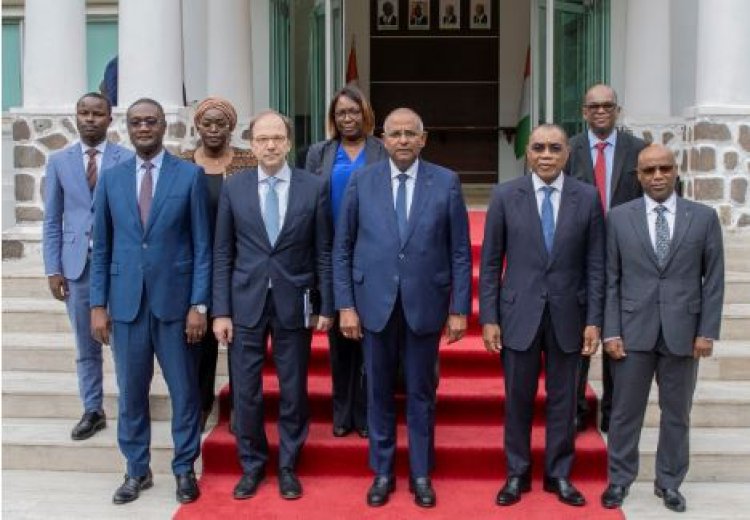
The IMF team met Vice-President Tiémoko Koné; Prime Minister Patrick Achi; Minister of Economy and Finance Adama Coulibaly; Minister of Budget and State Portfolio Moussa Sanogo; Minister of Planning and Development Nialé Kaba; Minister of State and Agriculture Adjoumani Kouabenan; Minister of Petroleum, Mines and Energy Sangawofa Coulibaly; and other senior government and BCEAO officials, as well as representatives of the business community and development partners.