IMF mission assesses the Ivorian Economic and Financial Programme
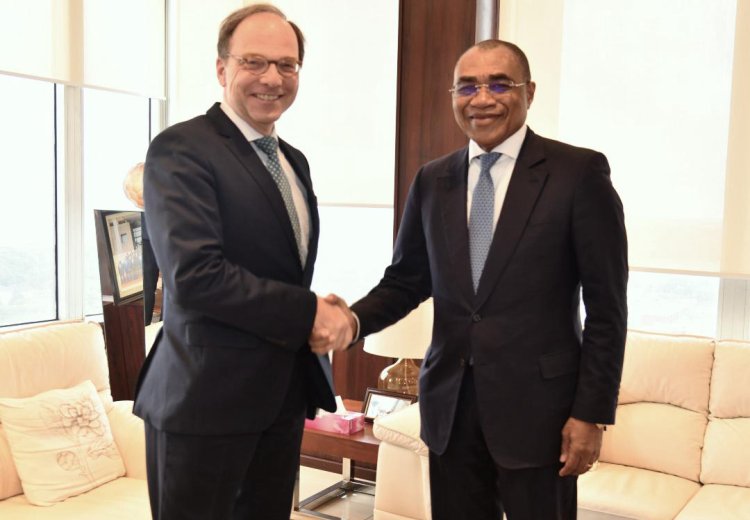
An International Monetary Fund (IMF) mission is in Côte d’Ivoire from 15 to 30 September 2025 as part of the review of the three-year Economic and Financial Programme concluded in May 2023. The mission began virtually and then continued in person; it was officially launched this Monday 22 September by the Minister of Finance and Budget, Mr Adama Coulibaly, at the Sciam building, in the presence of the mission chief, Mr Olaf Unteroberdoerster, and his delegation.
By way of reminder, since 2023 the country has received IMF support through two instruments: the Extended Credit Facility (ECF; FEC in French) and the Extended Fund Facility (EFF; MEDC in French). In 2024, it expanded this partnership by joining the Resilience and Sustainability Facility (RSF; FRD in French), which is specifically geared towards financing the climate transition. The current mission aims to assess implementation of these programmes, evaluate economic performance and make recommendations suited to the challenges ahead.
The results presented by the Minister confirm the strength of the economic fundamentals. GDP growth is projected at 6.5% in 2025, after 6.0% in 2024, driven by implementation of the 2021–2025 National Development Plan (PND). Inflation is expected to fall to 1.8% in 2025, compared with 3.5% in 2024 and 4.4% in 2023. The budget deficit is expected to stand at 3% of GDP in 2025, compared with 4% in 2024, reflecting a significant fiscal adjustment. The current account balance would also improve to –1.2% of GDP in 2025, from –8.1% in 2023.
In the medium term, ambitions are guided by the Côte d’Ivoire 2030 Strategic Plan, which projects average growth of 6.7% over 2026–2030. Production from Phase 3 of the Baleine oil and gas field is expected to generate a current account surplus and strengthen the economy’s resilience to external shocks. According to the authorities, the risk of debt distress remains moderate.
For his part, Olaf Unteroberdoerster praised the country’s economic trajectory and recalled that the IMF’s three-year programme, worth USD 4.8 billion, aims to structurally transform the Ivorian economy while strengthening its capacity to adapt to climate change.
The ongoing mission will help refine the outlook and strengthen cooperation between Côte d’Ivoire and the Bretton Woods institution, at a time when the country is establishing itself as a centre of economic and financial stability in West Africa.
Source : Sercom MFB, Rédaction Portail web MEPD